
Base Game
Game Overview
The German Hanseatic League [Latin: Hansa Teutonica] was a medieval association of merchants in northern Germany. Cities that joined were known as Hanseatic cities — an association loosely organised, never bound by formal contracts, comprising at any one time approximately 200 locations.
You are trying to increase your reputation as a merchant in the Hanseatic era. Establishing trading posts in as many cities as possible is one tactic; building a network of linked cities with tradesmen is another. Improving your merchant abilities can be equally effective.
During your turn you perform 2–5 actions. You can move your traders and merchants on the game map or use them to displace opposing tradesmen. If you manage to occupy all of the connections between two cities, you can set up a trade route and establish a trading post — or, in some cities, develop one of your five abilities instead.
The player who has scored the most prestige points at the end wins.
Components
- 3 Game Boards: The Hanseatic League (front: 4–5 players / back: 3 players), The Eastern Hanseatic League (3–5 players), and Britannia (front: 4–5 players / back: 3 players)
- 135 Traders (wooden cubes, 27 per player colour)
- 20 Merchants (wooden discs, 4 per player colour)
- 5 Writing Desks — Player Boards, one per player colour
- 15 Bonus Markers (3 in gold = start markers, plus 2 blank)
- 9 Mission Cards
- 6 Emperor's Favour tiles
- 1 black wooden cube for the Completed Cities track
- 1 Scorepad
Traders vs. Merchants: In the rules, traders (cubes) and merchants (discs) are referred to collectively as tradesmen. When a rule says "tradesmen" it applies to both. Whenever the distinction matters, the specific terms are used.
The Board
The game board shows cities that are part of the Hanseatic League, each with 1–4 trading post spaces (square spaces for traders, round for merchants) in four privilege colours: white, orange, pink, black.
Connecting the cities are trade routes with 2–4 connection points. Five cities (Groningen, Stade, Lübeck, Göttingen and Halle) have pictograms indicating which ability you can develop when you complete a trade route next to them.
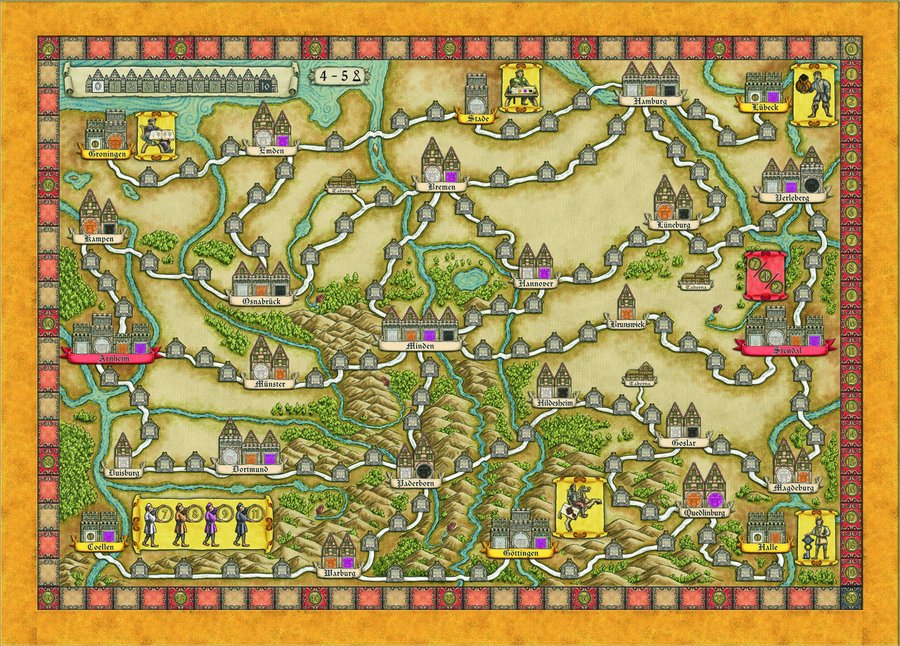
The Hanseatic League game board
Special locations on the board:
- Coellen — opportunity to win special prestige points (7, 8, 9, or 11)
- Stendal & Arnheim (red banners) — the termini of the East-West Connection
- 3 Taverns — the starting positions for the three gold bonus markers
- Prestige Point track — marks each player's score during the game
- Completed Cities track — counts how many cities have had all trading posts filled
Player Board & Abilities
Your writing desk (player board) tracks five abilities that can be developed throughout the game. At the start each ability is at its lowest value. Developing an ability reveals the next level and returns a tradesman to your personal supply.
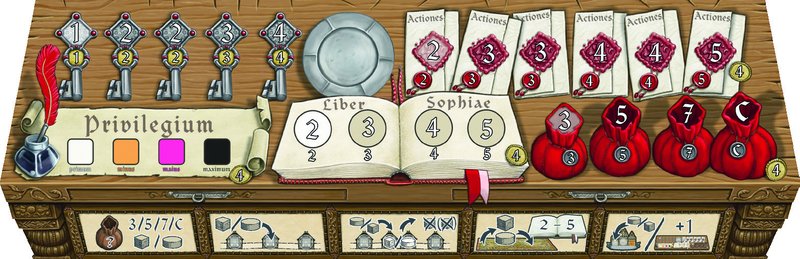
The player writing desk with five ability tracks
The leftmost space of each ability is left empty at setup. The value showing in that space is your starting value. Developing an ability removes the leftmost tradesman from that track and returns it to your personal supply, revealing the next (higher) value.
Gaining a higher Actions value (e.g. revealing the 3, 4, or 5) immediately grants you the extra action — even mid-turn, including when triggered by a bonus marker.
Game Setup
- Place the game board of your choice in the centre of the table. (For your first game we recommend The Hanseatic League.)
- Take the 3 gold start bonus markers and randomly place one on each Tavern, arrow pointing to its trade route.
- Shuffle the remaining bonus markers facedown next to the board as a supply.
- Place the black wooden cube on space 0 of the Completed Cities track.
- Each player chooses a colour and takes the matching writing desk and tradesmen.
- On your writing desk, place 3 merchants on the round Book of Knowledge spaces and 15 traders on the square spaces for the other four abilities — leaving the white-shaded leftmost space of each ability empty.
- Place 1 trader on the 0 space of the Prestige Points track.
- Determine a start player. Distribute remaining tradesmen as shown below:
| Player | Personal Supply | General Stock |
|---|---|---|
| Start Player | 5 traders + 1 merchant | 6 traders |
| Player 2 | 6 traders + 1 merchant | 5 traders |
| Player 3 | 7 traders + 1 merchant | 4 traders |
| Player 4 | 8 traders + 1 merchant | 3 traders |
| Player 5 | 9 traders + 1 merchant | 2 traders |
You can only use tradesmen in your personal supply for placing on trade routes. Tradesmen in the general stock must first be moved to your personal supply using Action A (Income).
Your Turn
Players take turns in clockwise order. On your turn you have 5 actions to choose from:
- A Income
- B Place 1 tradesman
- C Displace 1 opponent's tradesman and replace it with 1 of your own
- D Move your tradesmen on the board
- E Create 1 trade route
At the start of the game you may only take 2 actions per turn. By developing the Actions ability you can increase this up to 5 per turn. During your turn, actions can be performed in any order and the same action may be repeated. You must fully complete each action before beginning another. Using a bonus marker does not cost an action.
Actions A–E
Depending on your Bank ability level, hire up to 3, 5, 7, or all of your tradesmen from the general stock into your personal supply.
If fewer tradesmen are available in the general stock than your Bank value allows, you only hire those available. You can only place tradesmen on the board from your personal supply.
Place 1 tradesman from your personal supply on any free connection point on a trade route (one not already occupied by you or an opponent).
It doesn't matter whether other connection points on that route are already occupied. If you repeat this action during your turn you may choose a different connection point for each placement.
Remove one of your opponents' tradesmen from a connection point on a trade route and replace it with 1 of your own from your personal supply.
- If you displace a trader: pay 1 extra tradesman from your personal supply to the general stock.
- If you displace a merchant: pay 2 extra tradesmen to the general stock.
Your opponent must immediately place their displaced tradesman plus the same number of replacement tradesmen from the general stock on free connection points on adjacent trade routes of their choice.
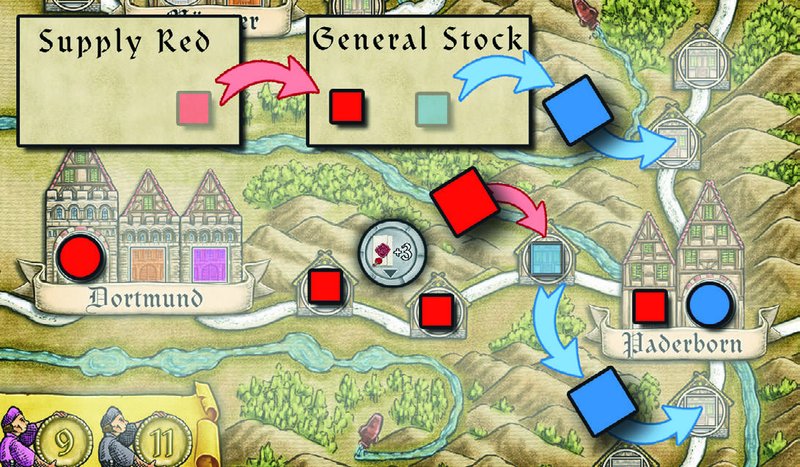
Example: Red displaces Blue's trader between Dortmund and Paderborn
The displaced tradesmen may be spread across 1 or more adjacent trade routes. If all adjacent routes are full, the opponent may use routes further away. If they have no tradesmen in the general stock, they may use their personal supply; if that is also empty, they may use tradesmen already on trade routes — but these must be placed immediately on a route, not returned to the personal supply. An opponent may decline the additional tradesmen from the general stock.
Move 2–5 of your own tradesmen (depending on your Book of Knowledge level) from connection points on trade routes and place them on free connection points on any trade routes.
You may swap a trader and a merchant with 2 moves. You may not displace any opponent's tradesmen during this action.
You may only perform this action if all connection points on a trade route between two cities are occupied by your own tradesmen. Filling the points doesn't create the route automatically — you must explicitly take this action.
When you perform this action, carry out the following steps in order. Steps 1 and 2 must always be done (as far as possible); then you may choose one of three alternatives in step 3:
Step 1 — Score Prestige Points
Check who controls each of the two cities at either end of the trade route. The player with the most trading posts in a city controls it and immediately gains 1 prestige point. (On a tie, the tied player occupying the highest-valued post — furthest right — wins the city.) If one player controls both cities they gain 2 prestige points immediately.
If any player now has 20+ prestige points, the game ends immediately after this action completes.
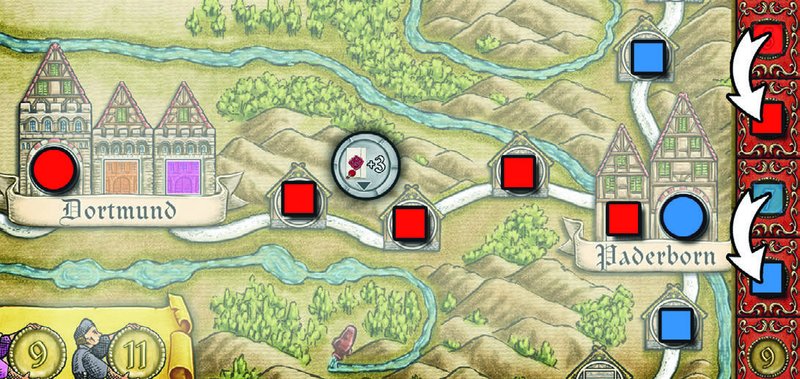
Red controls Dortmund (1 post); Blue controls Paderborn (higher-valued post wins tie)
Step 2 — Take Bonus Marker
If there is a bonus marker next to this trade route, take it and place it faceup to the left of your writing desk. You may use it once at any time on this or a later turn — using it does not cost an action. After using it, flip it facedown and place it to the right of your desk.
Immediately take 1 new bonus marker from the supply and place it facedown on the silver plate on your writing desk. At the end of your turn you must place this new marker on any trade route observing these restrictions:
- The trade route cannot already have a bonus marker.
- There cannot be any tradesmen on the route.
- At least 1 trading post space must be empty in one of the two adjacent cities.
If the bonus marker supply is empty when you must draw, the game ends immediately after this action — before you can use the bonus marker you just took from the board.
Step 3 — Choose one (or skip)
You may choose exactly one of the following, or skip step 3 entirely (in which case all your tradesmen on the route return to the general stock):
3a — Establish Trading Post. Return all but 1 of your tradesmen from the route to the general stock. Use the remaining 1 to fill the leftmost vacant trading post space in one of the two cities at either end. You cannot skip over a vacant space — you must fill the lowest available one. Traders (cubes) go in square spaces; merchants (discs) go in round spaces. Your Privilege ability must be high enough to fill the colour of the chosen space.
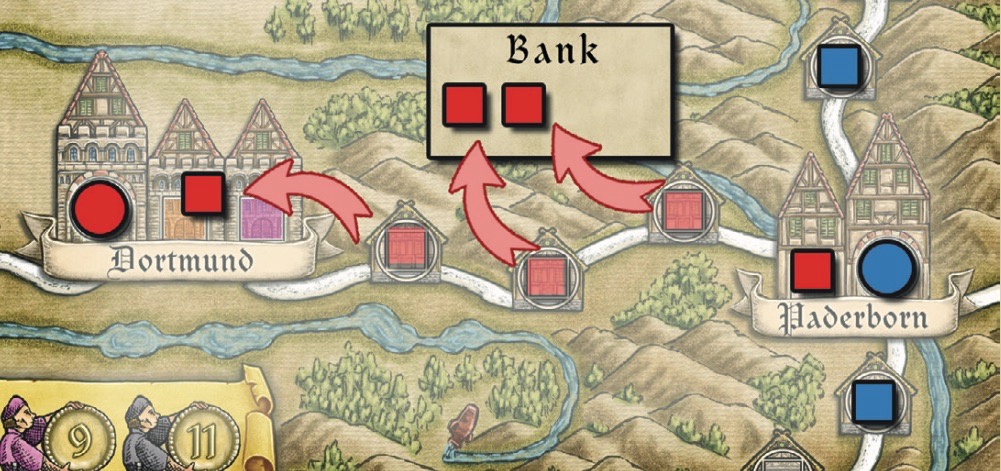
Red establishes a trading post in Dortmund using a trader from the completed route
3b — Develop 1 Ability. If one of the two cities has an ability pictogram, return all tradesmen from the route to the general stock and remove the leftmost tradesman from that ability track on your writing desk, placing it in your personal supply. You now benefit from the higher ability value.
3c — Score Special Prestige Points (Coellen). If you create the trade route between Coellen and Warburg, instead of a trading post you may place a merchant from the route onto one of Coellen's four special prestige point spaces (7, 8, 9, or 11). You may choose any vacant space — skipping is allowed. Your Privilege ability must match the colour of the figure on that space. This merchant stays until end-of-game scoring.
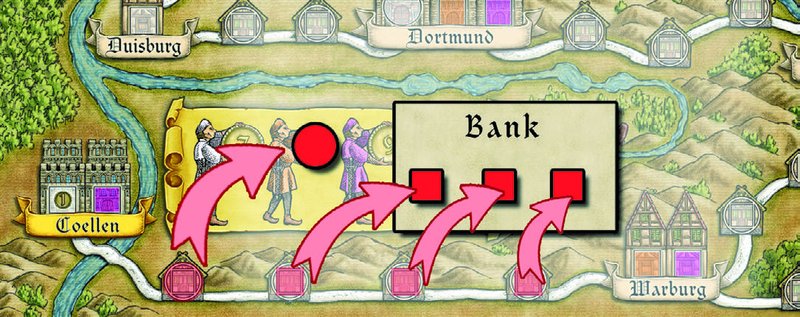
Red places a merchant on Coellen's 8-point space after completing the Coellen–Warburg route
East-West Connection
Immediately after you establish a trading post that creates a continuous chain of your trading posts from Stendal to Arnheim (the red banner cities), you have completed the East-West Connection and gain prestige points:
- 1st player to complete it: 7 prestige points
- 2nd player: 4 prestige points
- 3rd player: 2 prestige points
The length of the route, the privilege colours of your posts, and city control are all irrelevant — only the continuous chain matters.
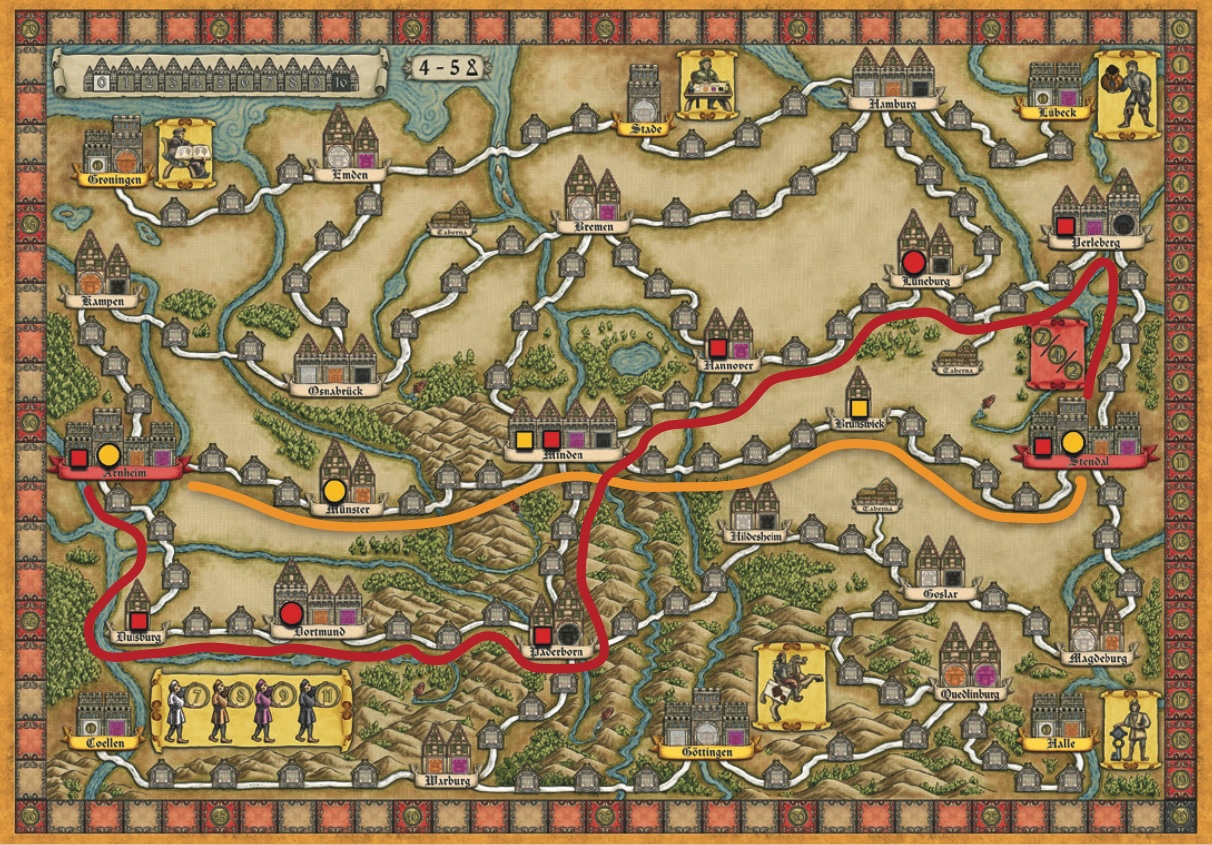
Two possible East-West Connections; yellow shows the shortest
Completing Cities
On the Hanseatic League board, you gain 1 prestige point immediately when you establish the first trading post in certain starred cities (Groningen, Stade, Lübeck, Coellen, Warburg, and Halle on the 3-player side; Groningen, Lübeck, Coellen, and Halle on the 4–5 player side).
Whenever a city's last vacant trading post space is filled, advance the black cube on the Completed Cities track by 1. If the 10th city is completed, the game ends immediately after that action. No further tradesmen may be placed in a fully completed city (exception: the Additional Trading Post bonus marker).
Try the five actions against bots — free, no account needed.
End of Game
The game ends immediately when any of the following three conditions is triggered during Action E. The active player completes their current action, but all remaining actions are lost and no further turns occur.
- Any player reaches 20 or more prestige points on the track (it doesn't have to be the active player's turn).
- The active player must draw a replacement bonus marker but the supply is exhausted.
- The active player establishes a trading post that completes the 10th city (Completed Cities marker reaches space 10).
Prestige points are gained during the game only through: city control scoring (step 1 of Action E), first-post bonuses on starred cities, and the East-West Connection. All other scoring categories are tallied after the game ends.
Scoring
After the game ends tally all prestige points across six categories. The player with the most points wins. In case of a tie, the tied player who has least developed their Actions ability wins; then most network points; then the tied players share victory.
Bonus Marker Scoring Table
| Bonus Markers Collected | Prestige Points |
|---|---|
| 1 | 1 |
| 2 or 3 | 3 |
| 4 or 5 | 6 |
| 6 or 7 | 10 |
| 8 or 9 | 15 |
| 10 or more | 21 |
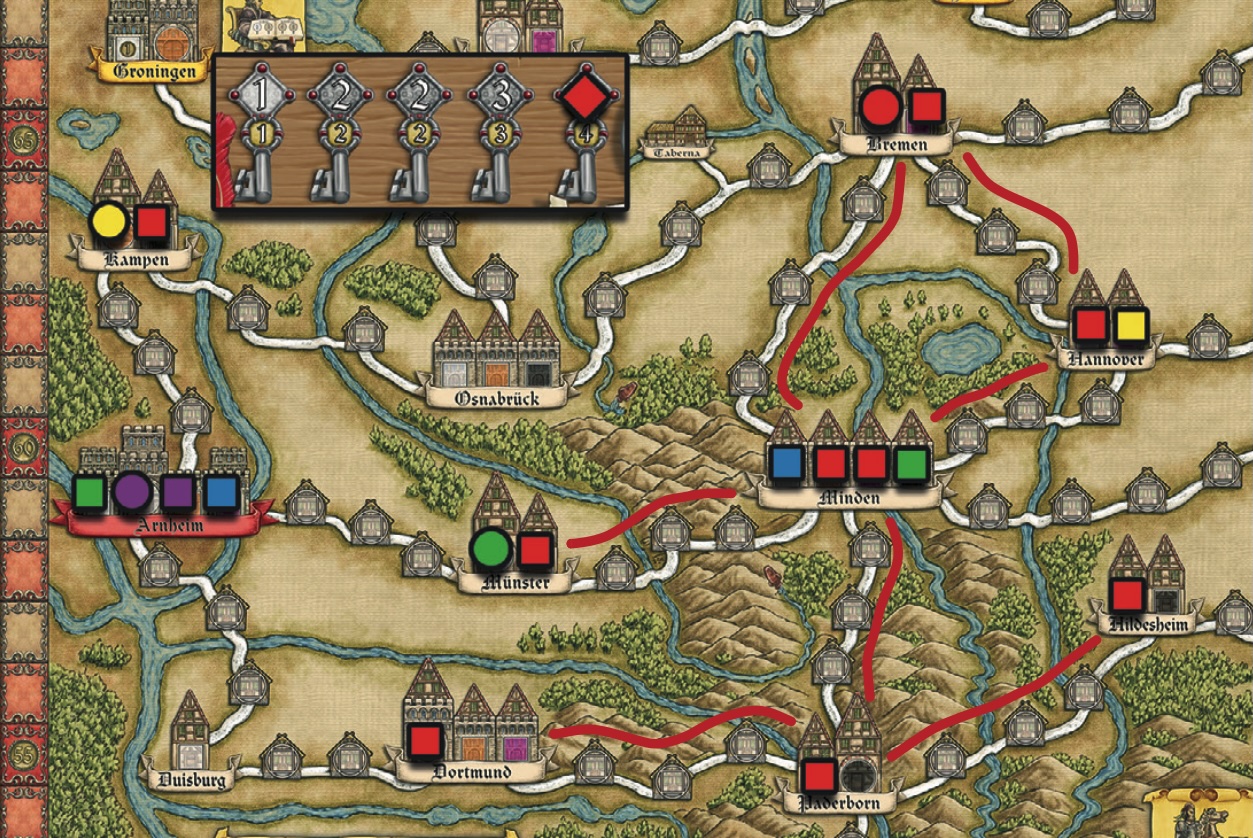
Network end-of-game scoring example: The red player has built a network of 7 cities with a total of 9 trading posts. (The trading post in Kampen is not included because it is not adjacent to any other city in this network.) Because he has developed his City Keys ability to 3, he receives 3 prestige points per trading post in this network for a total of 27 PP.
Bonus Markers
At the start of your turn there are always 3 bonus markers on the board. When you create a trade route with a bonus marker, take it faceup, draw a new one from the supply, and place the new one facedown on your silver plate. At the end of your turn, place all new markers on valid trade routes (not already having a marker, no tradesmen on it, at least 1 open trading post space in an adjacent city). Bonus markers can be used once at any time during your turn (not the same action in which you took it). After use, flip facedown. All markers — used or not — count for scoring.

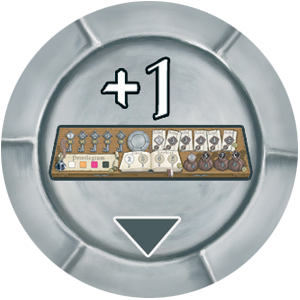
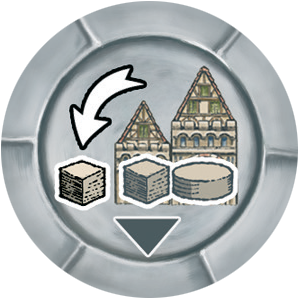
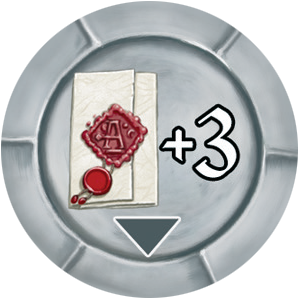
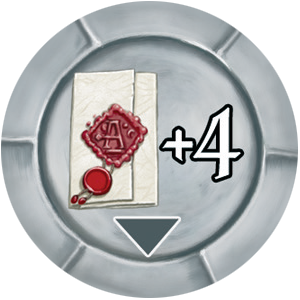
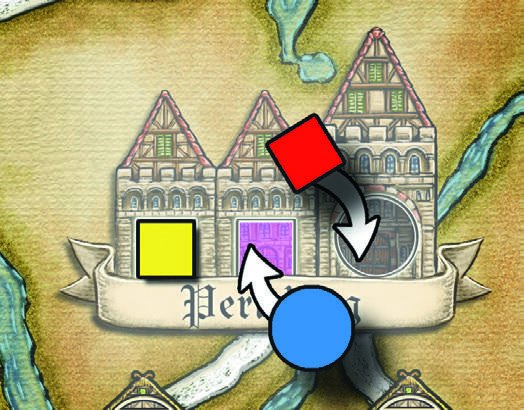
Red uses Exchange Trading Posts to swap with Blue in Perleberg, even without the matching Privilege level
Expansions
Beyond the base game, the Big Box adds 2 alternative game boards and 2 optional modules for experienced merchants — all covered below.
Want to play these on Hansa Teutonica Online? The Eastern Hanseatic League, Britannia, Mission Cards, and Emperor's Favour are all included with Premium.
🎖 Try PremiumAlternative Game Boards
Alongside the Hanseatic League board covered above, the Big Box includes two further game boards — The Eastern Hanseatic League and Britannia. Both play by all the core rules already described, with a handful of new elements layered on top.
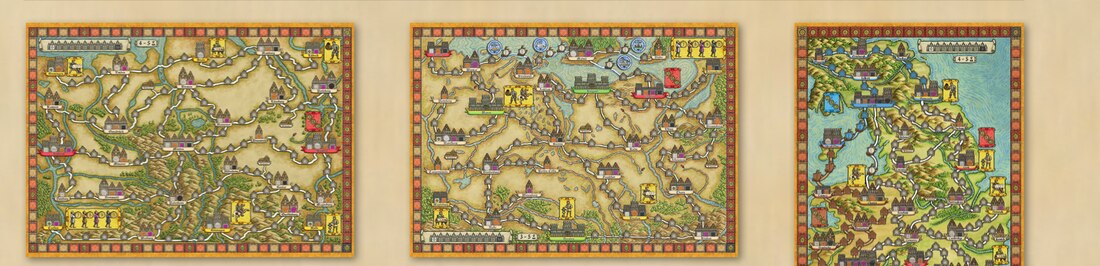
All 3 boards included in the Big Box
The Eastern Hanseatic League
The Hanseatic League expands eastward into new territory. New connections must be made, and maritime routes requiring merchants play an important role. Cities that don't belong to the Hanseatic League want to create their own networks — you must meet these new challenges to confirm your reputation as an accomplished merchant.
Setup is identical to The Hanseatic League, but there is just 1 board for 3–5 players. The East-West Connection here runs from Lübeck to Danzig, and you can gain special prestige points in Königsberg. All rules for The Hanseatic League apply unchanged.
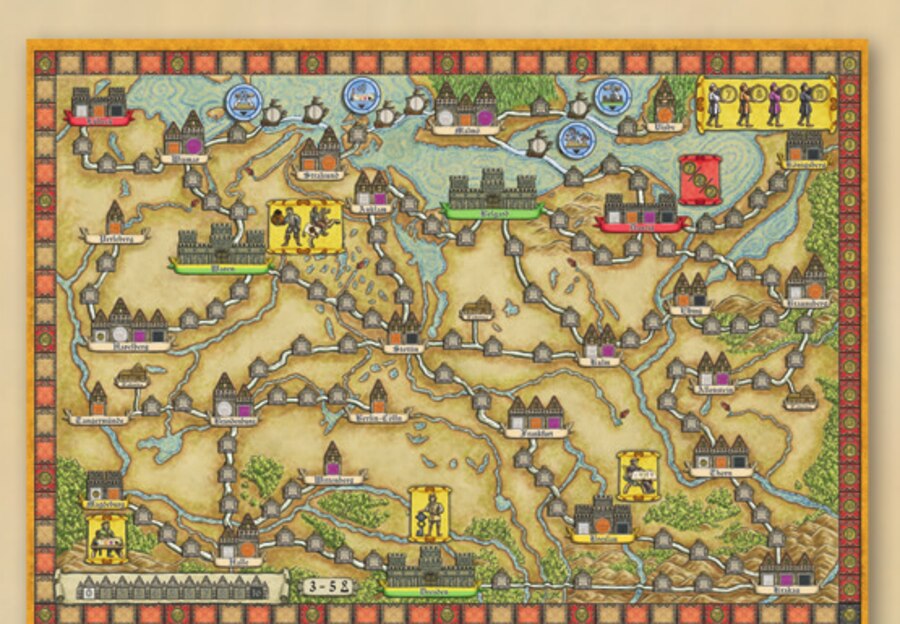
The City of Waren offers a choice of 2 abilities to develop — Actions or Bank. If you create a trade route next to Waren, you may develop either ability, or establish a trading post there following the (yellow and) green city rules below.
(Yellow and) Green Cities — Belgard (yellow), Waren, and Dresden (green) are not Hanseatic cities. You cannot establish a trading post there as usual; you may only do so by using the permanent bonus marker Establish a Trading Post in a (Yellow and) Green City, or the regular Additional Trading Post bonus marker when creating a trade route adjacent to one of these cities. Once occupied, treat them like any other Hanseatic city for prestige scoring.
Maritime Trade Routes
Maritime trade routes have two special features:
- You need 1 or 2 merchants to create a maritime sea route. (These connection points are shown as boats instead of houses, and only have circles for merchants — no squares for traders.)
- After creating a maritime trade route, you immediately gain use of a permanent bonus marker assigned to that route.
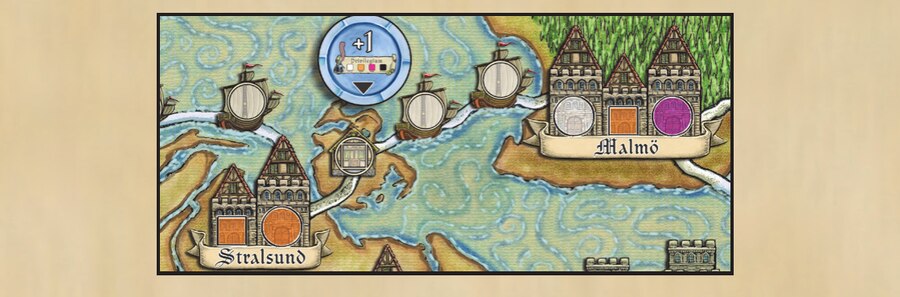
Maritime trade routes use boats and merchants only, and always carry a permanent bonus marker
You cannot place a regular bonus marker on a maritime trade route — there's already a permanent one there. Maritime routes are also the shortest path for creating the East-West Connection between Lübeck and Danzig.
Permanent Bonus Markers
One permanent bonus marker is assigned to each of the 4 maritime trade routes. You may use it immediately at the end of the action that creates that route, and only then — it cannot be saved for later, and it earns no prestige points at the end of the game.
Britannia
Setup for Britannia is the same as for The Hanseatic League. The 3-player map covers only England and Wales; the 4–5 player side of the board adds Scotland. Trade routes and city names are colour-coded by country: white/black for England, brown for Wales, blue for Scotland.
To establish an East-West Connection here you must create a continuous chain of trading posts from Oxford to York. You can gain special prestige points in Plymouth. All rules for The Hanseatic League apply, with these exceptions:
- The game ends immediately once trading posts have been established in all spaces of an 8th city (instead of the 10th).
- You may not place bonus markers on maritime trade routes that already carry a permanent bonus marker.
- You may not place bonus markers on trade routes in Wales or Scotland.
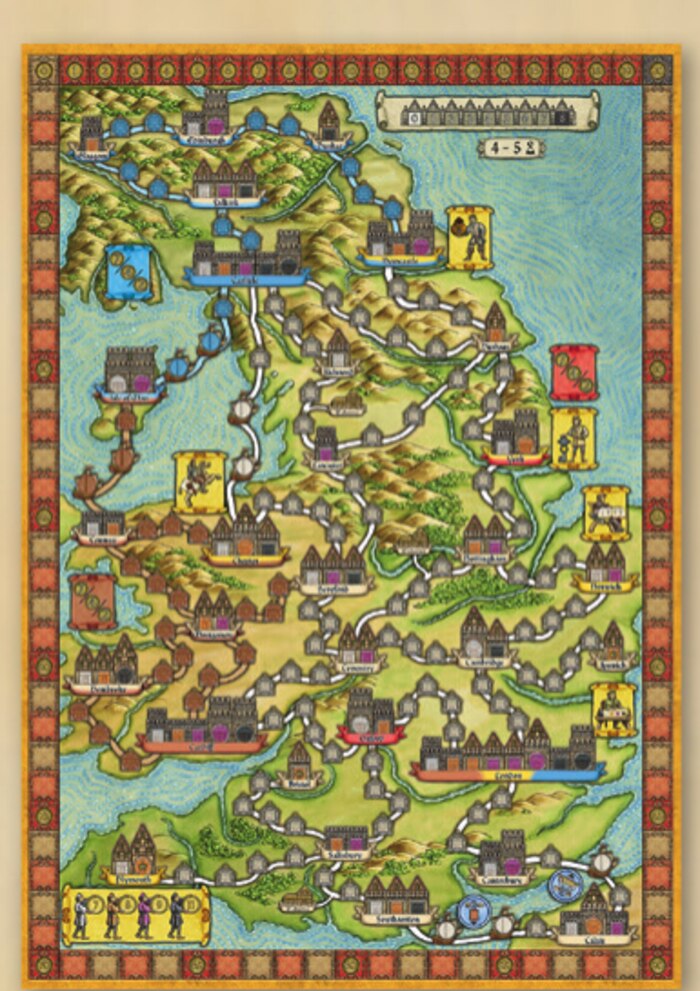
The Countries of England, Wales, and Scotland
Within England, you may freely perform actions B and C as usual. In Wales and Scotland, you need permission to perform these 2 actions — granted by controlling a specific city:
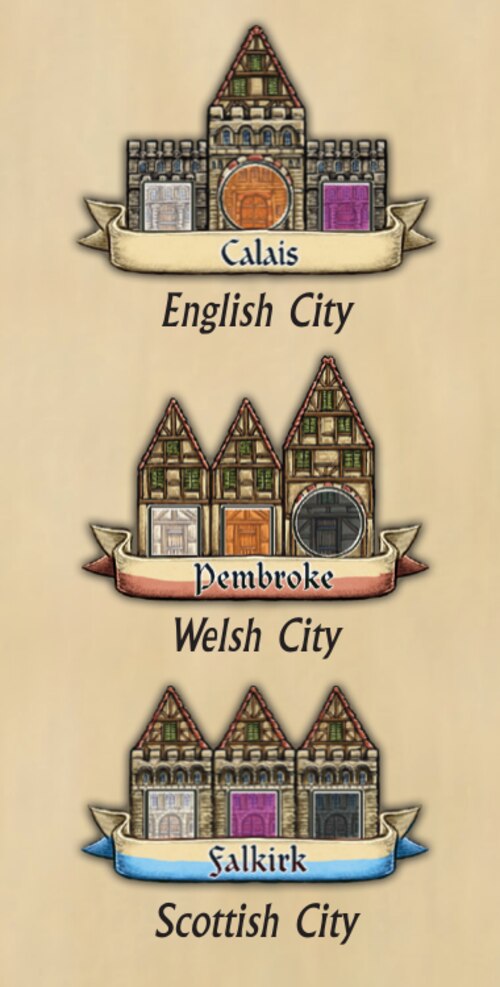
Cardiff (Wales): if you have the highest-valued trading post in Cardiff, you may perform action B or C once per turn in Wales.
Carlisle (Scotland — 4–5 players only): if you have the highest-valued trading post in Carlisle, you may perform action B or C once per turn in Scotland.
London (England): if you have the highest-valued trading post in London, you may perform action B or C once per turn in Wales, or (with 4–5 players) in Scotland. You can also develop your Privilege ability in London — that's why the London city banner shows 2 colours on the 3-player map and 3 on the 4–5 player map.
Holding the highest post in both Cardiff and London, for example, gives you permission to perform the action twice on your turn outside England (once via each city's permission). Action D (move tradesmen) needs no special permission, but tradesmen may only move within a country or into England — never directly between Wales and Scotland. Action E (create a trade route) also needs no permission in either country.
Move 3 Tradesmen bonus marker: when used on this board, you may only displace tradesmen within one country — a tradesman starting in England must still be in England once the action is complete. Swapping two tradesmen's positions within the same country is still permitted.
Maritime Trade Routes & Scoring for Wales and Scotland
Maritime routes work as described above. A permanent bonus marker is assigned to the 2 maritime routes in southeast England (both maps), plus the Isle of Man–Carlisle route on the 3-player map.
At the end of the game, score additional prestige points for controlling cities in Wales (and, with 4–5 players, Scotland): 7 points for most cities controlled, 4 points for second, 2 points for third. The Isle of Man counts toward both Wales and Scotland.
Emperor's Favour
An optional module for experienced merchants, played on The Hanseatic League board — on its own or combined with Mission Cards. Merchants in the Hanseatic League gained power and influence through brisk trade; the boldest among them purchased special permits directly from the Emperor.
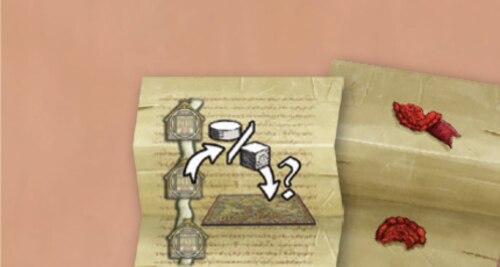
During setup, shuffle the 6 Emperor's Favour tiles facedown and reveal a number of them equal to the player count, placed next to the board. Return any remaining tiles to the box — you won't need them this game.
At the start of your turn, you may forgo all of your actions that turn to acquire 1 Emperor's Favour tile from the display, by flipping 2 of your own unused bonus markers face down and placing them to the right of your writing desk. (They still count toward your bonus-marker prestige points at the end of the game.) You may only acquire 1 tile per turn, and the tile you take is placed faceup in front of you for the rest of the game.
You need at least 2 unused (faceup) bonus markers on your desk to pay for a tile. Once used as payment, those markers are simply flipped facedown — they are not lost.
4 of the 6 tiles grant a permanent advantage during the game; the other 2 grant extra prestige points at the very end.
During the Game
At the End of the Game
Mission Cards
An optional module for experienced merchants, played on The Hanseatic League board — on its own or combined with Emperor's Favour. In the Hanseatic League of Cities, some cities enjoyed a greater reputation than others; merchants competed to establish the most trading posts in a manageable number of cities to gain the most prestige for themselves.
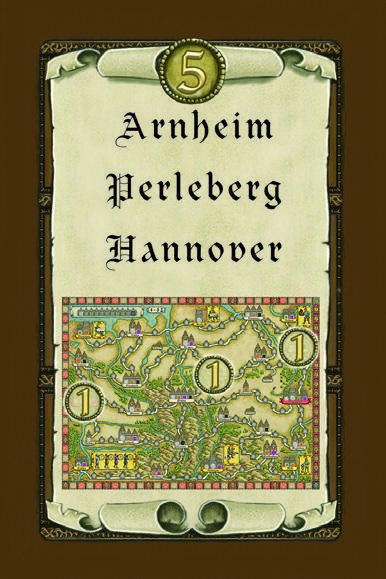
Each Mission card names 3 cities; small coin icons on the card show where they sit on the map
During Game Setup, shuffle the 9 Mission cards and deal each player 1 card facedown. Keep it secret from your opponents until the end of the game. Return any remaining cards to the box — you won't need them this game.
Each card names 3 cities. The first two named cities also appear on 2 other cards in the deck, so opponents could have the same targets on their own card. The third city is unique to that card.
At the end of the game, your Mission card scores prestige points in two ways:
- Gain 1 prestige point for each city listed on your card in which you have established at least 1 trading post (a maximum of 3 points).
- If you have the most trading posts in all 3 cities on your card (ties broken as usual by the highest-valued post, furthest to the right), gain an additional bonus of 5 prestige points.
In total, a Mission card can be worth up to 8 prestige points at the end of the game.
Game design: Andreas Steding · Illustrations: Dennis Lohausen · © 2020, 2024 Pegasus Spiele GmbH. All rights reserved.